Introduction
Have you ever seen memes centred around ‘passive income’? In case you haven’t, let me explain. Passive income, as its name suggests, is income from sources that do not require extensive and continued effort. A classic example of this is stocks or mutual funds; once you buy a share, the investment will change its value over time.

(Passive Income Meme, explanation: average human don’t live long enough for $1,000,000)
However, when passive income becomes no longer passive, troubles start to kick in. High-Frequency Trading(HFT) is defined as trading activities on investments with high velocity and frequency (Aldridge, 3.3). This high frequency weakens the correlation between normal market variables and stock value, and this change in the frequency impacts variables like sentiment, prediction, short-term data that could make permanent effects. Stakeholders like share owners, companies and exchanges are just the immediate impactors, but its butterfly effect may one day shake the global economy.
Trading in the Ages
In earlier times, trading required brokers. In contrast to today, where clients have complete freedom of choice with their available cash, the broker is often ‘the person’ that decides what to buy and what to sell. They’re the intermediary bridge between investors and the securities exchange. Investors would have to visit or call the broker to make an investment, and the investor would wait to collect enough buying power from his clients to satisfy the minimum requirement to buy a piece of the stock via parchment to the exchange. The excess procedure, slow delivery and high threshold to play made broker-centric investing exclusive and slowed. [1]
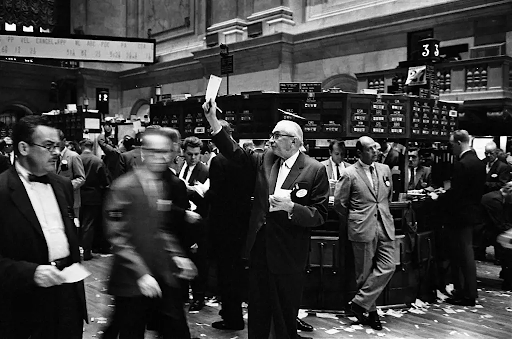
(Trading in the pre-internet, broker centric era)
State of the Art Colour Palette
The above model was how people traded in the 1970s. Fast forward to where the internet is in suitable shape and making solid impacts; I’ll introduce two parts to the evolution. First, let’s talk about hardware.
Hardware
HFT is all about speed; to satisfy the goal of profit, the high frequency meant high volumes of trades in a short period of time. This requirement is unachievable in the 1970s, and necessary hardware must be in place to execute those calls.
The development of technological hardware laid the essential foundations for HFT. In the millennials, personal computers became available to individuals, and security exchanges became accessible to everyone. Some brokers transitioned into portfolio managers and investment consultants, but more are replaced by brokerage companies that provide ‘self-service’ to individuals. Investment information is now streamlines of electronic data and is actively monitored and delivered. This information is then received by investors within seconds; with this information, HFT traders can execute their orders efficiently at their desired time point and price level.
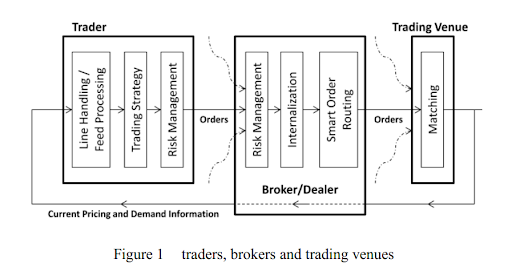
Here’s a detailed graph into HFT hardware:
 [3]
Behind those steps are thousands of machines and servers handling the service commands. Because of the short interval, GPU, CPU and power supply are all required in this process. Every millisecond reduction in latency can improve arbitrage profitability by more than $100M a year.[2]
Field-Programmable Gate Arrays (FPGAs) offer the performance of custom hardware without compromising on flexibility or latency.[3] According to Glider’s Law, The total telecommunications system capacity (b/s) triples every three years, and the bandwidth grows at least three times faster than computing power. And these are the primary supports for market data to transfer. With the growing cost of cooling and computing, the moore’s law is no longer relevant. Thus FPGA based computer is in place to handle quantitatively use cases with minimal latency. [4]
In the use case for trading, FPGA provides reconfigurability and parallel workflows. This is due to the multi-core structure that allows tasks to run at the same time. One model of primitive FPGA hardware is netFPGA, made at Stanford University. It consists of two static rams for two streams of tasks, and two SATA gates allow data to transfer together. [5] This unique advantage omits tedious complications for task management at the OS level and allows for customizability for HFT firms.
To Ethics
These technical advancements broke the current system and propelled the stock market. However, the constant power to power millions of FPGA devices is a high cost. For one, these hardware are used in cases where no intrinsic value is applied. HFT requires a high ticket to onboard, and the use of the technology is to profit in markets. Compared to artificial intelligence or machine learning, which already have use cases in medicine, autonomous driving and much more, HFT lacks the impact that extends to ground level.
For another, HFT also costs lots of energy. “The State Ecology Department says enough permits for generating power have been issued in Quincy to eventually pump out 337 million watts — roughly a third of the output of a major nuclear power plant.” [6] It’s also worth mentioning this quote is ten years old, so this data only gets larger. The problem with why there isn’t a new report is data transparency. Although the market data is available to the HFT algorithm, much of HFT itself is a myth to investors. These are considered business data for HFT firms. On one side, a competitor may predict the complexity of the algorithm, number of devices and trading strategy, and vice versa; the general public has minimal clue as to its carbon footprint. Being anti-eco-friendly is a trade-off that firms made for low latency trading, and the green is a sacrifice they’ve taken.
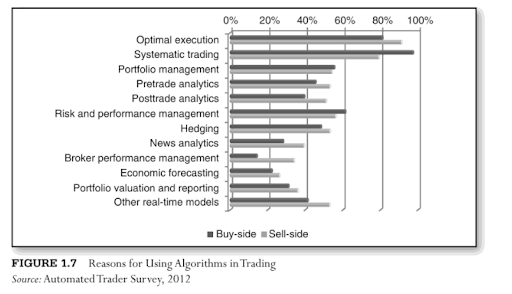
Now, with the support of hardware advancements, algorithms are in place to make analyses on commodities.
 [4]
Algorithm trading accounts for 70% of all market trades, and the above graph shows some of the most popular reasonings.[7] The most popular ones are for systemic and optimization reasons. Why so? Because we can apply statistics to study the data of our trades and even further develop the algorithm for it to execute at better times or simply for better profit.
Party for the Wealthy
 [2]
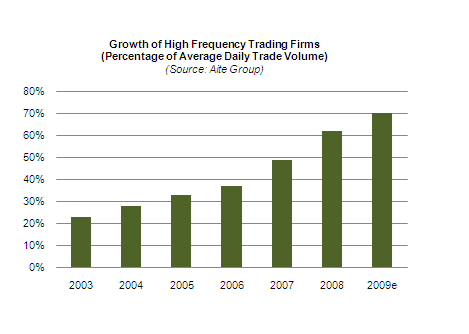
Insider trading is a term that’s used for company insiders that have private information about the company and profits based on the information. HFT, also provides such an edge to its users. Here’s the process, when an algorithm detects a large buy request from an investor, it orders all the available market shares at the current price. Microseconds later, when the investor’s brokerage is finding shares, they face an empty market. HFT algorithm then sells it for a higher price or simply takes away the opportunity for profit. The investor may take the rigorous analysis on the status quo, recent events and stock prices; however, their orders are ‘hijacked,’ and profit at quantities are taken away. Even if the order executes without turbulence, HFT algorithm got a ride from billionaires and may potentially benefit.[8]
This poses a serious question on market fairness. Insider trading is an offence that may result in jail time. In the case of HFT, there aren’t such regulations, and the lines are ambiguous. In such a grey space, it’s hard to determine the right use of technology. However, if we stay consistent in treating technology like human actions, we deem them unjustified and faulty. Under this principle, regulations are likely needed in place for this unfair advantage. Taking a look at the European Union, Efficient Capital Markets Hypothesis (ECMH) has been developed to test HFT’s impact on volatility and regression. Many HFT algorithms are tested in this environment made of past and present data. However, many of these algorithms did not rely on market news and data. Instead, they stayed with front-running techniques and exploited the gains at the capital market.[9] Thus, we call for a stricter regulatory environment on the HFT front-running edge. They should be complex but not foreign, as we have examples like insider trends in front of us.
Counterpoint
We must also look at both sides of the story. Many think HFT increases market liquidity at quantitative scales. It has made the cost per trade cheaper and eventually benefits mild investors in mutual funds and other commodities.
Market Manipulation
In October 16, 2014, The Securities and Exchange Commission(SEC) determined the first case of Market manipulation of HFT. The identified manipulation spanned over June-December 2009 and accounted for 70% of all Nasdaq trading volume of the affected stocks. SEC disclosed that the HFT firm Athena’s strategy was to be the major trading force in the stock and, if possible, be the only dominant force. Here, Athena adopted ‘Collars,’ an algorithm that ensures Athena’s order executes before others. This is not only using the front-running edge but also sweeping individual shares so they could build a monopoly. The share price will then be raised if they hold the supply and lowered if they sell off. As a result, the SEC has determined to fine Athena 1 million USD for this case.[10]
Behind Financial Crisis - A Monopoly
Looking over the case for Athena, high amounts of capital must be attained to buy the admission ticket to HFT. Without sufficient funds, it’d be impossible to set up the hardware, hire bright engineers for the algorithm, and eventually, money to execute these orders. With the above-mentioned advantages, HFT firms have recorded high gains(1 billion combined revenue for Virtu and Flow Traders). [11][12]
It’s hard for individual investors to process so much data, have their own algorithm, and have enough money to trade in high frequency. What’s more likely to be the case is their stock get piled in by HFT companies, and their anticipated earnings become alternated due to market manipulations.
Turning decision-making over to machines has not always benefited humans, notes Wharton finance professor Itay Goldstein. “People believe the crash of ’87 was caused by this kind of computer-based trading.” In that case, a vicious cycle swirled out of control as computerized trading programs dumped stocks in response to falling prices, causing other programs to do the same.[13]
Outside of Statistics
It’s also an interesting point proposed here to see the limitations of HFT, even without exploiting the market and utilizing correct statistical analysis.
Many changes are unforeseeable. For example, no one could’ve predicted the global pandemic in plain sight. As investors, these changes are outside of rational analysis and index data. There isn’t a single metric that encompasses these efforts, and investors don’t have ‘insider trading’ news even if they offend the law. However, based on experience, investors may expect such things to happen; it’s the scale and time which are not predictable.
According to Trinity College’s Soshua Stillwagon and NYU’s Roman Frydman, Chair of Knightian Uncertainty Economics at the Institute for New Economic Thinking: investors know about the unpredictable events that will occur in the future. In their perspective, brokers and humans are not mechanical robots, and decisions get impacted by emotions and meaning.[14] REM has limitations of its rationality, but it lacks the ability to predict these events.[15]
What Roman and Stillwagon proposes is that there’s a technological and psychological aspect to stock trading. Market sentiment is an essential element to analyze and can’t often be quantitatively measured. The psychological component often requires accessing its historical events, market trends, economic status and much more. HFT algorithms to date cannot incorporate all those information. However, in this new age of AI, HFT algorithms will be more enabled in the financial world.
References
[1] Smith, T. (2023, May 12). Broker: Definition, types, regulation, and examples. Investopedia. https://www.investopedia.com/terms/b/broker.asp
[2] R. Martin. Wall Street’s quest to process data at the speed of light. Information Week, 4/21/07
[3]J. W. Lockwood, A. Gupte, N. Mehta, M. Blott, T. English and K. Vissers, “A Low-Latency Library in FPGA Hardware for High-Frequency Trading (HFT),” 2012 IEEE 20th Annual Symposium on High-Performance Interconnects, Santa Clara, CA, USA, 2012, pp. 9-16, doi: 10.1109/HOTI.2012.15.
[4] Mohammad Sadoghi, Martin Labrecque, Harsh Singh, Warren Shum, and Hans-Arno Jacobsen. 2010. Efficient event processing through reconfigurable hardware for algorithmic trading. Proc. VLDB Endow. 3, 1–2 (September 2010), 1525–1528. https://doi.org/10.14778/1920841.1921029
[5]J. W. Lockwood et al., “NetFPGA–An Open Platform for Gigabit-Rate Network Switching and Routing,” 2007 IEEE International Conference on Microelectronic Systems Education (MSE'07), San Diego, CA, USA, 2007, pp. 160-161, doi: 10.1109/MSE.2007.69.
[6]Groenfeldt, T. (2012, September 24). Data Centers as power hogs – will green issues impact high frequency trading?. Forbes https://www.forbes.com/sites/tomgroenfeldt/2012/09/24/data-centers-as-power-hogs-will-green-issues-impact-high-frequency-trading/
[7]K. Heires. Budgeting for latency: If I shave a microsecond, will I see a 10x profit? Securities Industry, 1/11/10.
[8]Picardo, E. (2022, July 13). Understanding high-frequency trading terminology. Investopedia. https://www.investopedia.com/articles/active-trading/042414/youd-better-know-your-highfrequency-trading-terminology.asp
[9] Eugene F. Fama, Efficient Capital Markets: A Review of Theory and Empirical Work, 25 J. OF FIN., No. 2, at 383 (1970), http://efinance.org.cn/cn/fm/Efficient%20Capital%20Markets%20A%20Review%20of%2 0Theory%20and%20Empirical%20Work.pdf [https://perma.cc/UXZ7-M44B] (archived Jan. 16, 2017)
[10] U.S. Securities and Exchange Commission. (2014, October 16). Press release. SEC Emblem. https://www.sec.gov/news/press-release/2014-229
[11] Virtu Financial, Inc. (2023). Virtu 2023 results. Virtu Announces First Quarter 2023 Results. https://s21.q4cdn.com/422114427/files/doc_financials/2023/q1/Virtu-Financial-Inc-Earnings-Release-Q1-2023_FINAL.pdf
[12]annual-report-flow-traders-2022.pdf
[13] Goldstien, I. (2009). The impact of high-frequency trading: Manipulation, distortion or a better-functioning market?. Knowledge at Wharton. https://knowledge.wharton.upenn.edu/podcast/knowledge-at-wharton-podcast/the-impact-of-high-frequency-trading-manipulation-distortion-or-a-better-functioning-market/
[14Lynn Paramorre ]https://www.ineteconomics.org/perspectives/blog/how-do-investors-approach-the-stock-market-in-a-wild-election-cycle era
[15] Frydman, Roman and Stillwagon, Joshua, Stock-Market Expectations: Econometric Evidence that Both REH and Behavioral Insights Matter (May 19, 2016). Institute for New Economic Thinking Working Paper Series No. 44, Available at SSRN: https://ssrn.com/abstract=2793421 or http://dx.doi.org/10.2139/ssrn.2793421